Federal Courts Without a Federal Bar
By A. Winston Andrews
The federal judiciary is a separate branch of the national government. This book asks whether its professional structure adequately reflects that independence.
Explore the argument ↓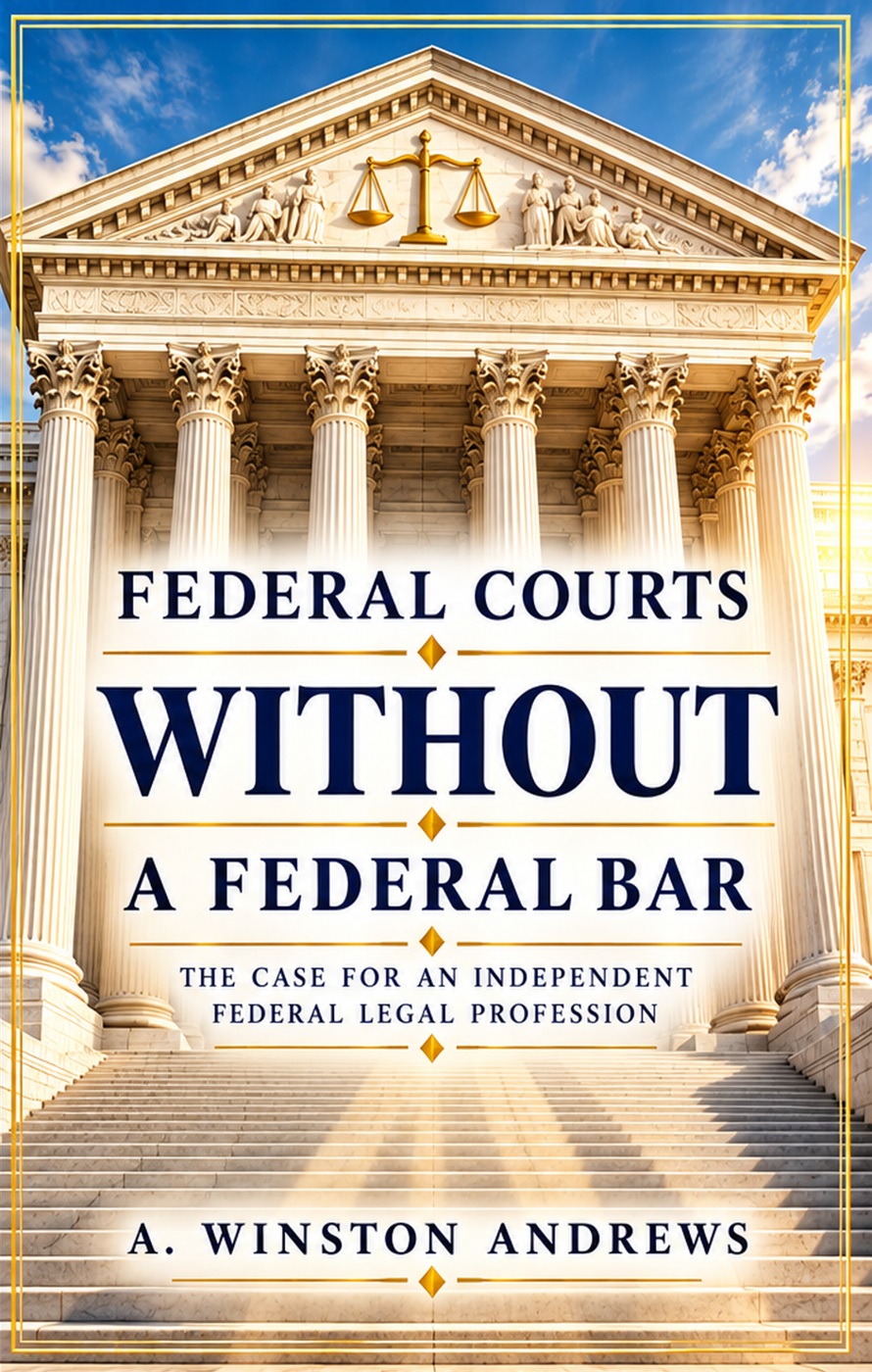
A sovereign judiciary.
Who governs its advocates?
Andrews examines the historical development of attorney regulation, its constitutional limitations, and the consequences of state-dominated disciplinary systems. He makes the case for a uniform, independent federal bar that protects advocacy and supports the federal judiciary’s national responsibilities.
“A sovereign judiciary should possess a professional structure corresponding to its sovereign responsibility.”A. WINSTON ANDREWS · FROM THE BOOK COVER
Judicial independence
How does control over the legal profession affect the independence of the courts it serves?
Professional discipline
How should disciplinary systems distinguish misconduct from advocacy and accountability from retaliation?
State and federal authority
What should a state licensing decision mean for practice before the courts of the United States?
An independent federal bar
What principles should guide a national professional structure for federal practice?
A career can end.
Who decides the facts?
Permanent disbarment can end a career. Reciprocal discipline can extend the consequences across jurisdictions. Should the public have a role in deciding the disputed facts behind such a judgment?
Andrews explores limited jury participation as an additional safeguard in exceptional disciplinary proceedings seeking permanent disbarment or comparably severe professional consequences—particularly where material facts are sharply disputed and the controversy carries extraordinary political significance.
A limited role for a jury.
An advisory jury or a jury assigned carefully defined factual questions could bring public judgment to genuinely contested evidence.
Judges retain legal authority.
Judges or disciplinary panels would remain responsible for legal conclusions, the governing ethical rules, and the sanction.
A safeguard to examine.
The proposal supplements notice, access to evidence, an impartial tribunal, written findings, and meaningful appellate review. The book also weighs the risks of added cost, delay, and inconsistency.
The book presents this as a question of institutional design. It does not assert an existing general constitutional right to a jury trial in attorney discipline or propose juries for routine disciplinary cases.
Discussed in the Preface (p. vii), “Jury Trial” (p. 58), and “The Limited Question of Jury Participation” (pp. 128–129).